


PDCA
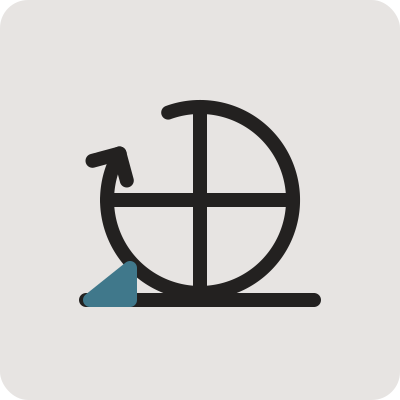
PDCA provides a four-phase framework for solving a shop floor problem based on measurements rather than impressions, and then for locking in the result with a standard so the wheel does not roll back down.
This course is intended for team leaders, methods technicians, continuous improvement facilitators and maintenance or quality managers who have to deal with a recurring problem on a line: repeated stoppages, scrap, OEE that stagnates. It assumes no prior Lean training.
By the end, you will know how to write a quantified problem statement and a SMART objective, trace back to root causes with the 5 Whys or an Ishikawa diagram, prioritise with a Pareto, test an action within a bounded scope, decide on comparable measurements whether it worked, and then record it in a standard. You will also know how to spot the three mistakes that cause most PDCAs to fail: starting from a solution, skipping the Check, not standardising.
What you will be able to do
- Name the four phases of PDCA and state what each one concretely produces on a production line.
- Write a quantified problem statement and a SMART objective with the measurement indicator chosen before taking any action.
- Trace back to root causes with the 5 Whys or an Ishikawa diagram, then prioritise with a Pareto.
- Run a test within a bounded scope and decide, on comparable measurements, whether the action worked.
- Standardise what works (the standard as the wedge for the wheel) and launch another cycle when the gap persists.
- Recognise the three mistakes that cause the majority of PDCAs to fail: starting from a solution, skipping the Check, not standardising.
The path
- Why a wheel, and why it turns in one direction only 4 min
- Plan, first step: frame the problem and set the objective 4 min
- Plan, part two: finding the causes and choosing the actions 4 min
- Do and Check: test within a bounded scope, then really measure 4 min
- Act: wedging the wheel with a standard, or running another cycle 4 min
Prerequisites
No Lean prerequisites. You need to know how your line operates and have at least one indicator that is recorded regularly (stoppages, scrap, throughput rate, OEE). Having a real problem in mind helps to follow the examples.
The closing quiz
The topic ends with a 7-question quiz, and a certificate is issued on success.